14 May 2013

Things I Like


Right now I am reading The Maias. Its a door stopper of a book and I want to bunk a day's work and curl up and devour it all in one gulp. Sadly I snatch reading time here and there to take it in. Thus far it is a classy soap that loves exclamation marks but that is just the plot, there is so much going on and Eca de Q is having so much fun and at the same time it is a sprawling, leisurely commentary on 19th century Portugal and I am entirely captivated and can't wait to finish it and restart all over again. Also I think I really really need to visit Portugal because whatever little I have seen and read (Mysteries of Lisbon, you are perfect) has been so absorbing and interesting that you have to remind yourself that these people are writing about themselves as the backwater of Europe.


I spend way too much time on tumblr, its like a rabbit hole you fall into and then you reappear and you want to write #IDK #holy fuck #excuse his beauty #obsessive replaying #cuz why not - because those are the tags you see along with other even more incoherent fangirling tags and then you realise that unlike most of tumblr which is VERY YOUNG you are on the wrong side of 40 and well perhaps a lyricist like Johnny Flynn doesn't quite deserve that and on that note here is his song, I am Light.  Only Nick Drake is rotated more often in Chez Anu. Pic Source here. And IDK is I don't know:)


And lastly, three cheers for Caravan which gets top marks not for being a great mag but for actually posting my favourite short story, Ras, in a new translation.  Even Indian cinema couldn't ruin it, not that it didn't try (to be fair it wasn't bad).


29 April 2013

Jane & Edward


In India, back in the day DD2 - bless them - would erratically screen UK TV programs and at the time they were the highlight of our TV viewing (yes cousins we have still not forgiven you for ruining the taping of a Jeeves and Wooster episode!).   Now that I have moved away, with UK shows being terribly commonplace here they no longer hold the same appeal. As an e.g. if Hugh Laurie and Stephen Fry appeared together in an episode of QI I would forgo it for an hour of…anything really.  Then one might even watch The Far Pavilions on the basis that the “British do period drama so well” but of course like Downton Abbey (a show I haven't bothered with) it was just an overblown soap with pretty looking people in historical costumes.   Recent sporadic viewings of respectively the very hokey The Paradise which never felt like anything Zola wrote and the more ambitious Parade’s End which took itself far too seriously and was deadly dull decided me that my rule of strictly rationed British TV period fare was warranted.  And then I saw Jane Eyre 2006.

Bronte’s novel of course heads must read lists. Mr Rochester is apparently everyone’s idea of a romantic hero and every now and then a film/TV version comes out which is duly whetted and slobbered over by the fan girls and further distances male viewers (with exceptions).  So though I did read positive reviews of the 2006 version I stayed away, more so since I didn't like the 2011 version – I went with my cousin for a girls night out and half way through we began regretting the unfinished wine bottle that we couldn't smuggle into the theatre.  The only version I did like was Welles'  version but that was not due to the movie itself or the performances in themselves. Rather I am a sucker for beautiful speaking voices and Welles' is top-shelf.  And then when I did get around to seeing the 2006 version, I was more than pleasantly surprised.  The production has its faults – the two segments that bookend the novel and do not feature Mr Rochester - Jane’s childhood and her time with St John and his sisters is fairly weak.  But it makes up for that with its central story which is so very charged that you finally see why Jane Eyre is an enduring romance.  All of this has to do with the leads. For the purists they do not exactly resemble their novel counterparts, nevertheless they do create the passion and feeling at the heart of what is an uncommon romance.  Ms Wilson’s performance is effectively restrained and filmic but Mr Stephens performance has dual qualities - old fashioned theatricality mixed with the toned down approach of film.  Normally I prefer the latter but some parts call for an actor who can manipulate language and knows how to deliver dialogue (and I have to admit that I miss this in modern film, both in India and elsewhere few actors know how to clearly enunciate and speak their lines) and Mr Stephens is adept at this.  On the other hand the performance is not all thespy either i.e. the kind of "look I am acting and I have cut glass vowels" performance which undermines so much British period drama or even the Orson Welles version. The proposal scene in Jane Eyre lies at the heart of the novel for it is not a simple proposal but also hints at Mr Rochester’s past and what is to come.  It requires not just a mellifluous reading of the lines but the line reading also has to convey Mr Rochester’s inner conflict. In this version it is particularly well done by Mr Stephens.  Unusually for a novel perceived as a romance for ladies, it has a very complex male character at the centre (he is also umm rather verbose!) and Mr Stephens digs into the role with relish and delivers and more (Indian audiences may know the actor from Mangal Pandey-and the actor really should have played Flashman, Update - well he has read the part!).   

All in all I felt myself ready to watch a bit more British drama:) And for once the interviews on the DVD extras were thoughtful and interesting.

Bronte’s novel isn't popular with everyone.  There have been postcolonial interpretations – and I am surprised the French haven’t complained yet (there is a good degree of this kind of insularity and protestant christianity in Bronte's novels, they are very much of their time).  For the new feminists Mr Rochester is the worst kind of male ideal, a forerunner of the bad boy and just the kind of man any sensible woman should avoid.  Comparisons with Austen come up though Bronte wasn't a fan (and the funniest comparisons of Rochester and Darcy apparently have no comments).  All this of course misses the point because Austen and Bronte are very different writers loosely united by that hateful phrase of our time, chick-lit.  Jane Eyre remains on reading lists because it is a beautifully constructed, powerfully written novel. Second Jane Eyre is not just a romantic novel.  It is not solely about finding the right husband in a society where cads and bores abound a la Austen.  Rather it’s about passion and feeling,  injustice and goodness, hypocrisy and cruelty and about being female and in the world.  Bronte feels all this very keenly - in Jane Eyre and in much of her other work.  Unlike Austen, Bronte’s  novels are not exactly romantic templates and unlike Austen her men are flawed and real.  Jane and Rochester are singular people and their romance equally singular, despite the lists it is not an "archetype" romance like Pride and Prejudice.  And most important of all though Jane Eyre gets a “happy ending”, you can imagine her life without it too.  Unlike Austen's novels where marriage is the logical end point, Bronte’s girl is her own person – you feel that with or without Mr Rochester she would have made her way through life on her own terms.  

__*__

My favourite period drama pieces however still remain non-British and rather French.  I loved The Mysteries of Lisbon (and Time Regained), the former I could watch endlessly.  I loved Breillat’s An Old Mistress.  And Untold Scandal was probably the best version of Dangerous Liaisons. 

28 February 2013

On my mother


The before and after of my life lies on the day my mother died.  This is always hard to explain, the sentimental misunderstand the nature of this feeling, the more pragmatic dismiss you as having a taste for melodrama. But anyone who has lost someone very close when young will immediately empathise, indeed a silent kinship runs amongst us.  Suddenly you are in new and uncharted territory, banished from the world you knew except as memory. In this territory hours and days will go by and each will mark the slow receding of that singular event from the world you inhabit.

It is twenty years since my mother died.  Just the other day I was astonished that she would have been 69 this year, by no means young but by no means an age in which death is inevitable.  In most ways my mother has faded from the life that surrounds me. There is hardly anything left of her in the places she inhabited, indeed it can be hard to say if anyone now remembers her very often apart from her children.  This is a natural outcome of the passing of time, every philosophy is at pains to tell you that oblivion stalks us from the moment we live. Still we hope for a little more and the now and then mention of my mother by people who knew her makes me happy, makes me feel she is still a little alive in this world.

Which is why I write this every year. To keep her a little alive. As the tiniest of flames but still there.

The photograph is of my mother in 1969, unusually in the fashions of the day. 

2 November 2012

Update

The vintage saree blouse has kind of taken over my spare time.  For the most part, it is interesting and I keep reformulating my views on everything past. I now need to make an illustration book of the blouse styles I have come across:) The constant  interplay between Indian attire and Western fashions and how specific each decade can be  in terms of blouse patterns, fabric and drape is fascinating.

I should perhaps cover a few of the later decades but the 1900s-1950s are still my favourites.  The last few posts I did have been on period drama and I was quite surprised at the care that had been taken over Sahib, Bibi and Ghulam.

For the folk who find tumblr difficult to navigate, the posts are now duplicated at wordpress. I could have duplicated it here but importing the stuff to wordpress proved to be easier. I myself love tumblr.  The friendliness of strangers, the completely mysterious ways in which a post goes viral.  The many tumblr names, all offering little clues to the person behind it. And that  post on some obscure book that is liked by a few and suddenly you are mysteriously connected to someone somewhere in the world who was as moved by it as you.

And I have another tumblr.  It is very much low key and intended to replace my facebook posts as I rarely use it these days.  I post now and then on the tumblr site and my intention is to keep it a "calm" space. So its probably going to be slowly populated but if you want the equivalent of reading a picture book while drinking tea pop over to text image poetry

15 September 2012

Nostalgia/Adultery


Puberty Blues is a well known coming-of-age novel set in Cronulla (yes, the riot suburb) which has been rebooted for a new generation and is presently screening in Australia.  In spite of its relative slowness for our times - its been pretty much set to a 70s pace - perhaps nostalgia and the persistent popularity of the coming of age novel has meant that the show has been a success.  Despite it primarily being a novel written in a "young voice", the TV story has been fleshed out to incorporate the adults. And there is as a result a lot of adultery - actual and contemplated.  Despite it being set in a milieu and culture vastly different from my own, there are some universal elements to it.  That one close friend, boys, acts of truancy. And many years later, a memory of the adult life of your parents with all its attendant responsibilities and miseries.

And remarkably the look of the serial evokes nostalgia - was the whole world in fact awash with a similar aesthetic sensibility?! My grandmother's plastic roses similar to the one above occupied pride of place in her house and I have seen so many of those landscapes (pic source here).  All I can say is perhaps some things should pass.
__*___

I just finished reading It Rained all Night - as it happens written in the late 1960s - a novella I enjoyed so much I am planning to order another book by the author, Buddhadeva Bose.  I have seldom read a better account of adultery - and really that is all there is to the novella, a wife has an affair and over a night husband and wife relay their internal thoughts. It did make me wonder though why so many Bengali novels have themes of female adultery :-)
__*__


Awhile back, I got around to seeing The Deep Blue Sea.  I love Terence Davies' films so I was looking forward to watching it and it didn't disappoint at all.  Like all Davies films it's not for everyone. It is slow and static at points, and there is none of the "lushness" endemic to period cinema.  The movie is set in postwar England and its curious in that it does not feel like a meticulous reconstruction of the past, it is the past. I haven't read the play but the movie itself is a detailed look at adultery, the title indicating that there are no choices in the situation.  It has some fine actors but the overall strength of the film is the way it is made. Long after it is over you are still immersed in the difficult, draining experience that adultery can be. Some of its more powerful images though are songs that evoke the communal experience of war and its aftermath. Given that it is a post war film, all around lie the ruins of the war so perhaps there is a subtext to the film of the country itself sloughing off a staid past and the excitement of a turbulent time to emerge into something uncertain. Certainly its ending shot suggests that.

__*__


The Blue Kite is among my favourite films so when Springtime in a Small Town came out I went along to see it. The tale of a wife in a loveless marriage with an ailing husband whose former lover returns to the eponymous town, it was disappointing on that first viewing.  I recently re-watched it and had a completely different reaction. Like with Terence Davies's films, there is little to immediately engage you, it eschews beautiful costumes, locales, drama - the basic ingredients of period films.  Instead on a second viewing it engages you like a novel.  Though the actors aren't always up to mark, you can "read" the film, without the immediate visual stimulation or conventional pacing you are more attentive to what lies beneath. Once you do this it turns out to be a rewarding film.  Like The Deep Blue Sea, Springtime too is Forbidden Love Among the Ruins-in the case of Springtime the setting is after the end of Japanese occupation.  Except that nothing uncertain yet hopeful emerges from this triangle, everything is statis.

__*__

Statis. A word and frame of mind I am grappling with at the moment. 

24 August 2012

Tumblring

Blogging after awhile.

Partly because of tumblr where I have been blogging a fair bit. It started because tumblr is an easy platform to catalogue interests and allows a bit more text than the purely visual pinterest.  On the other hand you can't have a lot of text like blogger - its a sign of the times that blogger now seems text heavy! Though my blog started as a catalogue of blouses in various decades, the material I found turned out to be an interesting insight into the early decades of the 20th century in India and its proving enjoyable thus far.

And then there's tumblr itself.  It's ruled by young people (the average age on the site is 24, most American) and gifs, as a result it is filled with youthful angst, silly things and the kind of trite sayings that are lent profundity only because it comes from young people experiencing life.  Consequently, its a place where a simple thing may get reblogged many times over while interesting pieces get little love. Nevertheless there are a lot of niche sites that cover everything from literature to science to art and its a bit like rummaging through an attic unsure of what one may find. Naturally in the context of my own blog I visit a lot of vintage fashion and history blogs and most are beautifully curated and informative.

On the whole tumblr is divided between fandom (of these the Sherlockians specifically Cumberbitches, Hiddlestoners and Whovians seem to be prolific and witty) and creatives-there are a good deal of illustrations and the like on the site, perhaps obvious given tumblr is such a visual platform. More well established folk like the New Yorker, Atlantic, Paris Review et al also post often and in some ways its easier to follow than visiting individual sites. Searching is easy because you can follow tags in a way that is hard with blogger and overwhelming with twitter.

Its a little hard to use facebook after tumblr, partly because tumblr has a more laid back vibe and there aren't the constant changes and privacy concerns of facebook. Except of course that tumblr is more a community of strangers than your friends or family. And tumblr is its own sealed world - almost no one I know uses it.

How long it will last I cannot say.  There is only so much cataloguing or curating one can do. Maybe next stop vimeo.....except I don't make movies:-)

PS: Of course the Tam in me has noticed that there is a davara-tumbler.tumblr.com :-) And the most popular Indian movie blog around seems to be dhrupad - interesting to see a lot of old movies finding new life on the Net but expect a lot of gifs. 

11 June 2012

Look Back and Repent

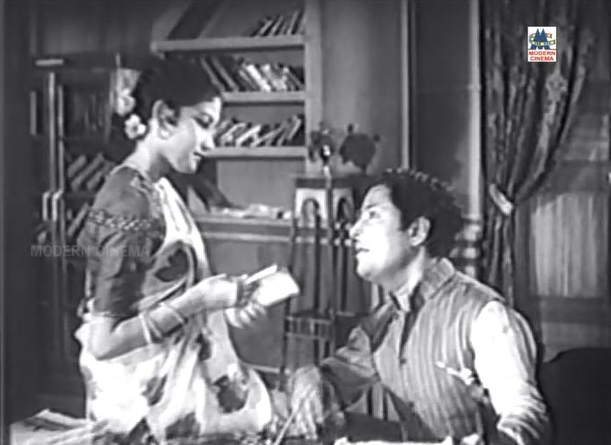
Of the three movies my mother had suggested - Parashakti, Andha Naal and Thirumbi Paar, the last had remained on my to do list for awhile. Thirumbi Paar turned out to be a meandering, not very engaging film and the only reason I am blogging about it is because there is very little on it on the Web. 

As with Manthiri Kumari, Karunanidhi takes an old tale and spins it into a modern tale castigating society at large, rather the political parties of the time.  The agitprop is tiring in this outing and there are so many story strands that you can't be bothered unravelling them by the time you have hit the half way mark in the film.  Briefly Parandhama (Sivaji Ganesan) is a thoroughly bad sort but his principal vice is seducing innocent ladies. Here's one caught hook, line and sinker - unfortunately the lady comes to a bad end but not before saying vengeance shall be mine!


But he is also overall bad guy and after awhile you can't keep up with his many nefarious activities which hilariously range from adopting a poet's identity to getting mixed up with union politics.  He's a Jack of all criminal trades so to say. Here he is smoking a cigarette and being a bad boy.


Conversely his sister is a super saintly sort who has brought him up - perhaps some passing virus infected him with criminality? - and you would normally be bored by weeping sister except that she is played by an actress of lambent beauty and grace (Pandari Bai). This woman must be Tamil cinema's best kept secret - she is excellent in all three movies I mentioned and the only reason to give Thirumbi Paar passing marks.


On her way to meet her niece, she meets the poet Pandian - whose identity was stolen by her brother - on the train.  By a series of circumstances Pandian, in spite of returning her love, ends up marrying her niece. Which makes Parandhama rather angry because he was quite looking forward to being the wolf to the niece's Red Riding Hood. 


Meanwhile Parandhama is consumed by rage and it's quite confusing keeping up with how bad he is being. If he is not seducing ladies, he is giving speeches hoodwinking innocent workers, maybe arranging for the odd robbery and also generally hanging out at some printer's joint smoking cigarettes and producing junk news. There's some odd sub-plots, a few songs which muddle the movie further. 

Things come to a bad, bad pass and in keeping with that old tale, the sister offers herself to the libertine brother. Whereupon he is brought to his senses and promises to reform but the sister cannot believe in this change of heart and kills him.


Not that you care.  I believe Karunanidhi was a very successful screenwriter in which case the Tamil appetite for bombast must be very large.  By this film I found myself growing tired of the verbal trickery, the dense dialogues and the politics of his films and longed for something much more elegant and sophisticated than the relentless barrage of words that seem to be his scripts. And it made me wonder whether Tamil cinema was ill served by being smothered in the rich sauce of Karunanidhi style language for decades.  Some unintentional hilarity does exist in these films given the travails and fortunes of the Karunanidhi clan, like what if the man did look back at all he has wrought?!
_*_

I might take a blogging hiatus after this unless there is something I really want to blog about.  I feel the need for something different, let's see how it goes....

26 May 2012

Favourite Boy


Review of Chaudhvin ka Chand here.

_*_

The Favourite Boy had his birthday some time back.

Every woman should have a Favourite Boy.  Favourite boy is not the husband or the bloke you are in a serious relationship with. Neither heaven forbid is he just a friend.  Instead Favourite Boy inhabits an enviable zone between the two i.e. a situation full of unconsummated romantic promise.

Favourite Boy is somewhat younger than me which famously discomfited him when we first met and wasn’t helped by my looking 25 for a very long time in my life thus confusing Favourite Boy.  Favourite Boy and I took to each other from our first meeting.  Favourite Boy and I would meet when we were in each other’s town and would write zany letters to each other when apart. If you wanted to go for a late night drive or stay up until 4 am talking rubbish or try strange alcoholic spirits or plunge into the sea fully clothed Favourite Boy was on hand. This has remained unchanged over the years.

Not every boy can be a Favourite Boy. For e.g. my Favourite Boy has a way with words, is good looking, quite the party man and can generally be expected to jolly one out of the moods. All these are attractive attributes in a Favourite Boy.  Another important thing is that Favourite Boy must have a new girl on his arm every now and then with whom he has a proper romantic relationship, this creates the proper framework for your own relationship with Favourite Boy.  Of course to be Favourite Girl, you have to ensure that you too have a Boy on the Go. Many a happy hour can thus be spent discussing these romances in a “we refuse to get there but what fun it is to discuss it our love lives with each other” way. It is entirely possible that Favourite Boy will marry one of these girls or be very intense about a few (or conversely you might) but with luck this won’t change the boy remaining Favourite Boy.

As you will guess a good degree of flirtation is the cornerstone of the relationship with Favourite Boy. You must at all times extravagantly praise the Favourite Boy’s looks, his attire, his house, his music and the like.   Yet you must also at all times verbally spar with the Favourite Boy on all this and run it down because frisson is also an important part of the relationship. Frisson and Flirtation. There in summation is Favourite Boy.

I have sat with Favourite Boy on ledges, benches, at the seaside, in a car, on a train, on swings and even on a tree.  A happy cloud of romance hangs over us always which we never dispel by way of an actual romance.  People waste their time agonising over what ifs or precipitate perfectly good Favourite Boy relationships into messy relationships.  Never must one do this.  For the pleasure of the Favourite Boy is in sitting side by side eternally, knees never touching.  So a toast to Favourite Boy!

_*_

Still reading RK Narayan, is he amongst the best Indian writers ever?  It feels as if my pleasure in reading Narayan has quadrupled over the years. Here, for e.g. is the sly humour of the opening chapters of Mr. Sampath, The Printer of Malgudi in regard to the offices of The Banner:

…….the other three windows opened on the courtyards of tenement houses below.  The owners of the tenements had obtained a permanent legal injunction that the three windows should not be opened in order to that the dwellers below might have their privacy.  There was a reference to this in the very first issue of The Banner. The editor said, “We don’t think that the persons concerned need have gone to the trouble of going to court for it, since no one would open these windows and volunteer to behold the spectacle below.”

This stimulated a regular feature entitled “Open Window”, which stood for the abolition of slums and congestion. 

12 May 2012

Fridays with Miss Fisher

Finding time – and the inclination – to maintain this blog is hard to come by.  A short post then.

Detective fiction is not a genre I am particularly enamoured with.  While Agatha Christie and Conan Doyle were staples for an Indian childhood, it wasn’t something I re-read into adulthood.  Miss Fisher’s Murder Mysteries is pretty much in the cosies genre and its TV adaptation like with most cosies isn't always strong on plot. Yet it’s addictive Friday night viewing and mixes all the cosy elements right.  It doesn't hurt that it is immensely beautiful to look at and nicely performed. 

I bought a couple of the books to read along with the TV episodes and while the two differ greatly, in tone the TV series remains faithful to the novels for the large part.  Phryne Fisher is sort of a female James Bond, a pistol packing, exquisitely dressed, fabulously rich lady of somewhat easy virtue.  Like with all perpetually upstaging clever private investigators, you tire of her a bit (hands up if you find Holmes insufferable!).  But the books are on pretty good form in recreating 1920s Melbourne and obscure details of Australian history with a slant towards female emancipation.  And Greenwood creates vivid characters which helps the transfer to TV. In spite of this the books themselves feel a bit undercooked here and there,  there is an element of a first-rate concept all dressed up with nowhere to go. The writing is equally hit and miss with the opening chapters of Cocaine Blues being rather clumsy.   Though completely different in tone, the books reminded me of Amitav Ghosh’s novels.  A wealth of detail, a few interesting characters and yet swathes that are curiously shallow and one dimensional.

Anyway all the viewing and reading of history-mysteries reminded me that it was time to revisit my favourite detective of all time, DCS Foyle.  Foyle’s War, here I come!