There a fair few Australian women painters and I had been meaning to do a post on them at some point. The death of Margaret Olley last week precipitated this post. It is by no means a critique, neither does it touch on lesser known painters, it's just a picture post. Some of the painters belong to the first half of the twentieth century; my interest in them is largely because of their representations of Australian life from that period.
Olley herself is a bit of an icon and quite singular judging from her interviews. The reason I chose this painting is because by some coincidence it was the first in my search and matches a cyclamen plant I bought this morning.

Yesterday the ABC ran a documentary on Olley and of course being a bit of a clothes obsessive, I was charmed by her liberal use of colour in her clothing even at an old age. And also charmed by her faded beauty - the only comparison I can think of is an unkempt rose bush :-)
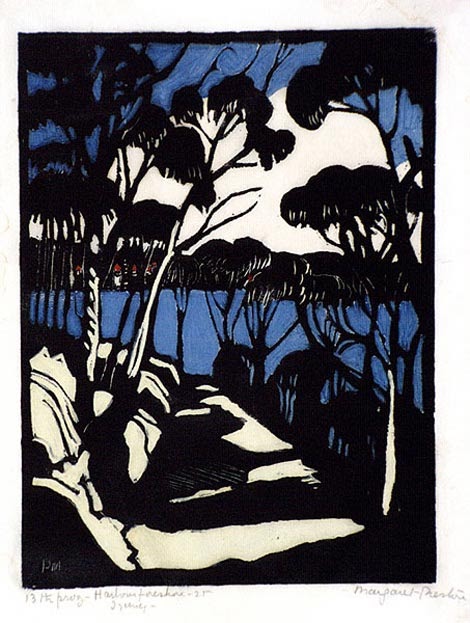
Margaret Preston is arguably the best known of the artists, there have been retrospectives of her work, much discussion on her aboriginal influences and the like. Her paintings (many are woodcuts actually) make liberal use of the Australian landscape which in a way keeps drawing me back to her. I often think of this woodcut when I am walking around the harbour, for e.g. And of course her floral still lifes are both extensive and beautiful.

Thea Proctor is not as well known but her woodcuts have a languorous air and are tasteful. Though The Rose is the woodcut you often find in merchandise, I like this one of the swing.

AGNSW had a retrospective of Grace Cossington Smith awhile back and though the collection was not as extensive as Preston's there's something intrinsically harmonious and pleasing in her paintings. There's a slight domesticity to her work (though she does have a few on city life and the making of the Harbour Bridge) but it's the colours that draw you in. The Lacquer Room is her most famous painting but I also like her yellow interiors.

Last of course there is Mirka Mora who is still very much around and had a book out that made clutter seem quite seductive (Olley seems equally at home with clutter). A lot of her work is also colour saturated and in her words "the optic nerve of the eye is so happy" when you look at these.


