Showing posts with label Cities. Show all posts

24 April 2011

Bangalore

Brief visit to Bangalore to meet friends who I was meeting after a long time. It all felt lovely - though you do worry a bit about the friends having to go out of the way to accommodate your schedule. Like a trip on a Sunday afternoon to see the  Maitreya Buddha Dhyana Vidya Viswalayam which turned out to be a fair distance away (Bangalore traffic of course is as chaotic as any in India, there are only degrees of differences).


I can't say I am big on new age philosophies or meditation so the place itself was of little interest. But the company was lively, the landscape charming and the place itself serene so it turned out to be a pleasant outing.


There are villages around the place - some very evocative of ancestral villages - so out came my camera but I ended up with just a few  because it was end of day.


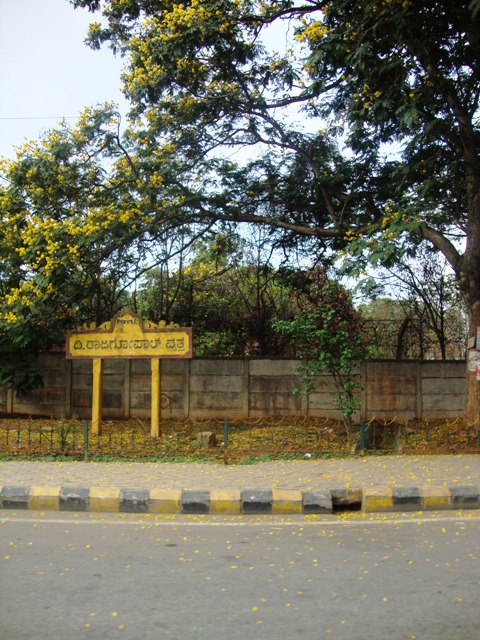
Bangalore itself has changed a lot from when I last visited. There is the long drive from the airport, the cars on the roads, the different languages on the street and the  buildings of modern India that are deluxe, prestige and fill the landscape. In other cities perhaps one thinks of it as the natural remaking of a city by a new generation, in Bangalore you are filled with a sense of wistfulness, regret for not visiting it when the city was at its best. Because the city is one of few in the country that has an aesthetic coherence.  Even the yellow distinctive road signs that dot the city now have an air of melancholy. And though there are moments like rain and darkening skies on a Tuesday evening or the blaze of colour afforded by the roadside trees that remain you know that the city's genteelness, its mellow beauty will not last.


Still, the trip felt happy.  One thinks often of friends (and family) but the pleasure of meeting is different. There is happiness in hearing a voice, in banter, seeing a face - the intensity of this catches one by surprise even in the closest of relationships. So perhaps a small thanksgiving for such events is in order.

30 March 2011

On the Road to Poona

Travelling to Pune always reminds me of the time when my parents lived at CME and I used to take the train every other weekend from Mumbai to meet them. Being a   cash poor and time rich student, I usually hopped on to any available empty train and spent most of the ride admiring the scenery or writing furiously in my notebook. Some of those pieces made it into the student magazine but most are lost, their vanishing a little unnoticed and perhaps justifiably unsung. The more common route these days is the Expressway and though the buses are quick and efficient, something of the romance of the trip is lost, especially the arrival into Karjat and the climb and descent from Khandala. A mid travel eating spot remains and though this centralised facility is a little different from the quick grabs from a station or unscheduled stop, the eats on offer remain somewhat similar. I took a few quick snaps on the break. 

The staples of train travel - nuts, berries, fruits are of course still around.

As is the vada pav and the omelette pav.  The Karjat sellers would be swamped but now things are a lot more leisurely.  The meal I bought reminded me of a line from English August, where an urban type becomes a babu in rural Maharashtra. Spying a market meal, he thinks of it with a cartoon bubble - Hullo, my name is cholera, what's yours? I survived  my meal just like August.
What I don't remember is the Science at Home. I was intrigued by this - who runs it? - but the bus left before I could ask questions.
In Pune, I caught up with friends and family.  We went to Kirkee, which is much changed. Mid way through my trip we took a leisurely drive through the cantonment. Which has also changed but the old bungalows survive.  I am not overly sentimental about Army life but there is something of an ease in  being among things that formed part of a life already left behind.

Visiting old friends in Pune also reminded me of the Marathi Natyasangeet tapes that used to play in our hostel rooms.  There was one particular song I liked and never found in a tape - of course it is on youtube.

4 January 2010

Kanpur evam Cawnpore

I was 10 when I went to Kanpur for my school admission. My father took me and we stayed at the Inspection Bungalow at Armapore and all I remember is not combing my quite long hair for a few days. My mother and brother arrived later; my hair was firmly plaited and as ever a temporary home was set up replete with a big bowl of delicate blue larkspur and yellow dogflower.

A few months later we moved to a home in the city on the ground floor of a house that belonged to local merchants. It was damp and dark and when it rained green slime flowed out of the pipes and into the courtyard. We had a long commute to school on the Army bus. We had little connection with the deeply traditional, Punjabi joint family who owned the place. Or their dog who left little piles of runny shit all over the house. Life passed unhappily, languidly. Summer afternoons were the worst - hot, unbearably still. The only event that enlivened these days for us was pheriwalas selling cucumber slices (evocatively described as “Laila ki ungliyaan, Majnu ki pasliyan” in our school lesson) and watermelon. Living there my mother went a little mad. So did our dog who singlemindedly tore up all our linen. Finally my father was allotted a house and we moved to the cantonment.

The cantonments of India in the 70s and 80s were both isolated worlds and connected by some invisible bloodline to the cities they belonged to. Cawnpore (to use the anglicised version) cantonment had roads named after English governor-generals and colonial bungalows that lined the Ganga. Once in a while bodies lazily floated in the river, no one knew if death had come from natural causes or otherwise. Here and there were the remnants of history like Massacre Ghat and Bibigarh. Cawnpore Club was a mouldy old place where drinks were served at six by liveried bearers and dinner was served in courses. We lived opposite the club. At night the lanes were dark, the trees cast long shadows. Visiting relatives were spooked by the darkness and silence but we felt immense relief away from city lights.

Our school had been set up by missionaries. Legend had it that a local rich boy had been rejected by our school and so a new school was set up right across the railway tracks that ran alongside our school. Naturally we disdained the students of the other school. Our school offered a sound education and we even had a few American teachers, this felt quite exotic at the end of the 70s. It also offered a sound thrashing for misdemeanours in the old public school tradition. And demented teachers who talked to themselves, like our Sanskrit teacher.  As also Hindi teachers who ensured our Punjabi Hindi was  erased and replaced with a purer diction. It was quite an old school and for some reason its historical photographs have got embedded in my mind so I remember it as a place populated by Victorian schoolgirls rather than us modern Indians.

My mother’s mood improved in the cantonment. She had a social circle more to her liking and was soon immersed in Army life as we knew it. One month Shia-Sunni riots broke out in the city. At its height, my mother had a previously scheduled party for which a rice plate was deemed necessary. In the midst of a curfew mother and daughter sailed forth, found a willing rickshaw wallah and an open store in Navin Market and returned with ceramic plate in hand. Many months later we encountered Sanjay Gandhi, campaigning for an election at the end of the Emergency that the Congress lost. He had a lone driver and a local chap in attendance and waved to a few of us in that cantonment country lane. In retrospect, it is a touchingly innocent moment.

If the cantonment was a safe haven in which our lives were lived out undisturbed, nothing prevented us from enjoying the delights of the city. Shivala had tiny shops and giant mounds of glass bangles which everyone bought – no one even knew or cared that these were made by children under appalling conditions. We simply wanted a colour for every mood, every occasion. You could pick up leather chappals – also dangerously made in the city’s tanneries - for a pittance. And the alleyways were filled with food stalls, including those that made kulfi by rattling the metal cones in a pot filled with ice.

Kanpur had unmotorised rickshaws which depended on raw pedal power. There was no other way of getting around the city if you didn’t own a vehicle. It was always an unhappy ride, especially since most drivers were emaciated men with leg veins that stood out. Jostling for space with these rickshaws would be cows and elephants like some stereotype of India writ large. I think the Mall had a cow that never moved and traffic simply went around the animal. Further slowing matters were the numerous gumtis or railway crossings across the city.

And there were the ubiquitous servants since most Army houses came equipped with “servants quarters”. Of ours, one was a widow with young children, rather sad and outwardly colourless. The other was still young and  our playmate. They had resoundingly epic names like Urmila and Shakuntala. Many a solitary evening whilst my parents were out at a party, Shakuntala would play with us and our two dogs. The dogs buried and dug up bones in the garden, which made us feel like we were living in a proper Enid Blyton story.

Kanpur was a strange city; it had none of the glamour or culture of neighbouring Lucknow. It had a history but it was an industrial city above all, though its proximity to the river also made it a city where everything bloomed. Menace hung around, even in the cantonment. Tales of abduction, thefts, murders were rife all the while we lived there. In the end we were happy to leave and arrive in a city where people roamed freely at night. I am in no hurry to revisit Kanpur but all these years later the memory of the city is a surprisingly pleasant one.

15 December 2009

In Krungthep

My brother lived in Bangkok aka Krungthep Nagari for awhile, this was written after my first visit. Revisiting my observations of August 2005 induced a great deal of lunch time nostalgic reverie.

Sydney is the Big Smoke of Australia but for an Asian things can seem pretty quiet around these parts. If you spend a year buried in Sydney where the sky has a blue permatint and barring the constant low hum of cars, the loud mobile phone wielders on the local train, the pounding music of the stores and the kaw kaw of seagulls nothing constitutes noise, it may well be that before long you will wish a holiday in more raucous parts of the world. And when you step off in the early dawn into the liquid heat of Bangkok, you know that this city is an antidote to your year in Sydney. A week in the city however merely affords fractured impressions. The river (Chao Phraya) and endless languid trips on a ferry. Fetid and clean klongs (waterways). More water in large pots on pavements housing pink lotus plants. Masses of pale green closed lotuses wrapped in banana leaves and immersed in large buckets of water. Spectacular wats (temples) seemingly serenely afloat on a concrete city. Large photographs of the queen. Shops, stalls, carts, goods, locals, firangs. Clusters of monks in yellow and orange robes, silent and everywhere. Dank Chinese shops (remarkably identical all the way from Singapore to Bangkok). Small perfectly formed eats. Iced coffees in plastic bags to ward off the heat and give a caffeine kick. More entwined pretty boys than Sydney. It can all seem a bit like the pictures of ubiquitous LP editions on Thailand. All of this was enlivened by an endlessly amusing game (for us) that my father and I devised - finding the Sanskrit equivalents of names ranging from Kanchanaburi to Thammasat. Even more endlessly amusing was my father's intrepid expeditions on local buses where the incongruous alchemy of his bad Thai and the commuters bad English magically transported us to desired destinations. Some things remain etched in memory. Wat Arun studded with the porcelain ballast of Chinese ships of the 1800s and looking for all the world like a modern art installation which makes use of discarded objects, an artist's comment on Thai-Chinese history. The emerald green landscape, misty rain and the Khwae river at Kanchanaburi - a stark contrast to the war museum it houses (the bridge on the river Kwai is here). The tranquility of Wat Bowon which is off the tourist track. Like many Asian cities, there is something seductive about Bangkok. Maybe because there is little room for anything else but people, the cities seem to reflect everything from a rarefied, sophisticated existence to the intimacy, squalor and corruption of spaces that coalesce into each other. Just the kind of place where a million stories can be born.

Picture credit: swamibu

23 August 2009

Madras, 7 years ago

Towards the end of 2001 (or perhaps early 2002) I went to Madras on a patent matter and spent a week there. I didn’t know much about the city, it had merely been a transit stop before we went on to the hinterland when on holiday. It was the first time I had stayed any length of time in the city and much of that time was spent meeting lawyers.

Our first meeting was with S. S was a well known barrister and the company was paying top dollar in hiring him. S spent much of his time in Delhi and as we later found was much wont to dropping names. He had a sea side bungalow in Madras and had flown down for the meeting. The bungalow was tastefully appointed in a style that could be called South Indian Modern. The inhabitants of the house, if any, were discreet though a dog roamed freely on the premises. S was voluble in the manner South Indians are, words issued from his mouth, collided, flowed on and while we marvelled at the man’s eloquence little of import was said. K, our local lawyer, was from Kerala and a neat, dapper man who seldom spoke. We ourselves barely got a word in. Eventually someone came around with the coffee. In fact we found that victuals (this word seemed very S, hence it’s employment here) were as measured in Madras as speech was not. In contrast, in Calcutta where a parallel case was running, sweets and tea punctuated every other hour so that we emerged more often than not in a sugar haze.

As it happened both S and K had little to do, as the matter wasn’t heard. This in spite of the fact that the Madras High Court appeared a model of efficiency compared to Calcutta’s. S flew back to his other important clients, the rest of our party departed leaving me to await a further court date. K, who also had a lavish bungalow, dumped me in his offices. These offices were dominated by exceedingly large gods and goddesses and people who went home to lunch but never offered you a glass of water or invited you out for a bite. During the long hours I spent there transcribing notes, K’s assistant, who sported many auspicious rings, ascertained my caste and then informed me that “we” were honest as we were too scared to cheat our employers. This seemed to imply that the intent lay underneath.

My cousin was then studying in Madras and we caught up a couple of times. This was the better part of my trip. Our jaunts in the hot, damp nights of Madras let me discover parts of the city I had never seen before. As in Calcutta, I was struck by the strong regional flavour of the city. In the day there was a businesslike, clear cut air to the city, partly I think due to the Tamil temperament. But in the nights, the city and the sea held a soft romance.

And in the evenings when I returned to my room in the hotel, I would pass temples and step out occasionally to visit one. The passageways would be long and dim and even the Gods would be barely visible bar a flash of silk or jewellery. On a smaller scale the householder’s evening rituals were replicated in numerous roadside shrines across the city. At the twilight hour, the world was briefly illumined, scented with jasmine before it slipped into the dark.

2 June 2009

Calcutta

Some fragmented thoughts on Calcutta.

1. I first went to Calcutta at the beginning of what turned out to be a brief and unnecessary affaire de coeur. During that year, I went to the city often and then more sporadically. I have a friend who never revisits the city where a failed romance had blossomed, at least in the immediate aftermath of a break-up. Because what I felt for Calcutta was a separate thing in itself, it was not a sentiment I felt hence my trips to the city since then have been intermittent only by virtue of distance.

2. A little bit of history. My parents briefly lived near Calcutta, at the height of the Naxalite period. My father was in the Indian Army, given the political climate he had armed escort. It was not without reason; a civilian friend of his was gunned down not minutes from his home. This and the dislike some Bombayites feel for a city that is so different in temperament meant my mother never took to the city. My father, brought up in the East, was more at ease with it though he never lived there for a long period of time. Years later I went to the little town they lived in. It was a dusty, nondescript town with nothing to recommend it.

3. In the 80s, it appeared that everyone was either filming or writing about Calcutta. Perhaps it was a time when we were a little closer to the Raj with which the city was then inextricably linked. Perhaps we were also more preoccupied with the peculiar mix of literary culture and extreme poverty that Calcutta provided. Ray was still alive, Ghatak not that long gone, Joffe's City of Joy was in the offing and numerous coffee table books and travelogues were published on the city. These days, it seems to have fallen off the radar a bit. Bombay, Bangalore and Delhi seem more representative of a new India that mixes the sentiment of home and the world with ease. It is a decade in which Mumbai has gone to the Oscars and Delhi is the basis for so many new films. Once marginal cities like Bangalore are now pretty much shorthand for the new India. It is not that Kolkata is forgotten. Occasionally it is the setting for an India themed film (After the Wedding, Shadows of Time, Born into Brothels), it pops up on TV screens here when Steve Waugh visits but by and large it is a less visible part of the new India.

4. I last went to Kolkata six months ago. Arriving in Calcutta, you are already elsewhere. It shares the languorous feel of the cities to its east like Bangkok and that feeling is only enhanced by the fact that it is in a different time zone but is artificially aligned to the rest of the country.

5. In the late evening, the centre of the city was clogged and full of smog. Traffic and people seemed to be in eternal circulation creating a peculiarly persistent noise. Park Street had a kind of darkness marginally dissipated by yellow light that was so common in most Indian cities a few decades back. In contrast, everything in Mumbai was neon lit and the autos had long switched to CNG. Bombay was thrusting itself into the future, Calcutta as ever seemed mired in the past, though Calcuttans themselves thought the city was changing. As always, the city’s dim lights and its slowness were alternately charming and exasperating.

6. People in Calcutta are eccentric in a way you don’t see elsewhere. Tram drivers with aloof expressions trundle through the city. A friend went to buy a kurta and received a dressing down for not choosing one immediately. I once went to a public library - itself a grand building set on an unkempt lawn. My queries were rewarded with gloomy stares and a certain air of cultivated, slow (that word again) indifference only seen in Calcutta. Then suddenly someone saw it fit to take an interest in me, a sudden disconcerting smile cracked his face and I was ushered into a room with mouldering documents. Similarly off Park Street is a place where they sell fine embroidered linen which is run by a charity and appears to keep a few women in employment. After very many occasions of the surly service that only Calcutta stores seem to possess, an unexpected voluble amiability.

7. The taxis in Calcutta always carry the driver's cronies, perhaps to relieve the tedium of the ride. One visit I took just such a cab late at night and we went through a newly built freeway of sorts. It was ill-lit and lonely, I bawled out the guy. He stopped and turned and said This is Calcutta, We are Gentlemen and true to his word deposited me at my address.

8. At Flury's on my first visit, a gentleman in a kurta and a jhola and a woman in a pale, starched sari-both middle aged and in the throes of an illicit romance.

9. Lastly, yet again past the road to the airport, dust blowing by the side, unexpected patches of green and water, the dark faces of the East, a friendly driver, sweet shops, saris hoisted on shop fronts and then home to Bombay.

31 May 2009

Canberra

My cousin has been visiting and last week I took her to the nation's capital, Canberra. When we arrived, it appeared likely to fulfill its reputation for dullness. There were wide streets which were strangely depopulated, boring government architecture, spaces through only cold winds seemed to blow. It was as if nothing had been touched by imagination, even the houses seemed a uniform brick. Given that Canberra is government town, this you thought was what a safe, middle class world looked like. On the positive side, its very middle classness gives it the NGA, cycling rides around Lake Burley Griffin, decent book shops, a university feel and the like. In fact in the night we were surprised to find the city restaurants and cafes to be quite lively. I once had the idea of opening a chocolate bar (as one does inspite of not quite liking the stuff) - but they appear to be quite the thing given Sydney has Max Brenner and Melbourne TheoBroma and yes even Canberra has Koko Black.

Then again, I have lived in towns like Canberra and there is nothing to say that the internal worlds of Canberra residents are any less vivid than those of people elsewhere. Perhaps we have become too accustomed to wanting to live in "happening" cities, to wish every city to be tourist ready and can't appreciate those that adhere to neither.


As the above sampler of pictures shows, Canberra's natural setting is quite spectacular (the pictures are taken at the lake and in the city). Even this like the city is partly man made - the lake was created for the city and the tree plantings ensure a spectacular autumn and spring. But the backdrop of the straggly bush set on flat spaces and the cold clear air which in itself is akin to a relaxing massage is all Canberra's own.

12 April 2009

Jamnagar circa 1979

1. I must have been 13 or 14 when I went to Pirotan Island. If I cannot remember the exact age I can remember the mood of that time, that cusp between childhood and full blown adolescence. We lived in the cantonment, a speck on the speck of the map that was Jamnagar. An army green Shaktiman took a motley group of defence children to school, we came home to the same people. We played cricket with Ronnies, Buntys and Sunnys; an assortment of unchanged names that accompanied us each posting. I had just learnt to ride a bicycle and my brother, willing victim, sat pillion. We endured a million falls which left the tar and dust of the cantt roads in our mouths. In the evenings, we played with our dogs on the small patch that we maintained as a lawn, perpetually brown in Jamnagar's saline heat. My mother, conscious that she no longer had a child but a daughter on her hands, tried to instill manners and the use of cold cream every night. I, both precocious and not so, eschewed both in pursuit of books on Dialectical Materialism. At 13 I was a Marxist without understanding a single word of what I read.

2. The memories of my life that have remained crystal clear are often associated with water. These memories are so visceral and sensory that I can recall the feel and taste of every kind of water, from the slanting sheets of a Mumbai monsoon to my first taste of the Australian sea. It need not even be its physical presence; it could for example be a school lesson on the monsoon, my father's recitation on a summer night in Delhi making it a movement of winds, evaporation, condensation and precipitation, of water running over conversation and textbook. Likewise, the old tank hoisted above my grandparents house is gone but the splendid sense of isolation and coolness one felt sitting atop it and the thrill of opening the lid and peering into its dark waters hasn't. That single memory can encapsulate my entire childhood and everything I feel about my grandparents and their old home.

3. Circa 1979 if my mother was wary of sending me to Pirotan, she did not say so. Because I was in many ways a child, she perhaps did not want to frighten me into the awareness that I was nearly a woman. For like everything else in my life, I came to that realisation late. The girls at my school were different; there were rumours of boyfriends, older men they would meet on the sly. One girl was rumoured to be a lesbian (and when I think of her now I wonder how it must have been for her in that small town; nothing other than Radclyffe Hall's well of loneliness). But I was remarkably uncurious in some ways. I heard it all but it meant nothing and I remained preoccupied with Marx, politics, history lessons, old songs and novels in no particular order. I wore my frocks high above my knees, read my mother's books, dreamt my days away and had few friends unlike our previous postings.

4. The school's expedition to Pirotan Island was the first of its kind. There was nothing on the island bar a lighthouse; I cannot remember any residents. Our guides for the expedition were a few young zoology students from Rajkot's university and by the time we arrived a few long huts with a thatch and nothing by way of walls had been built. This was where the girls were to sleep. In the day we would explore the island and at low tide the sea. The students would find and explain marine specimens - crabs, jellyfish, mollusks – the jellyfish a white, cold slab - and we would hold them and make notes in our books. In the night, the food would arrive laced with the kerosene from the stoves on which it was cooked. The bolder girls would slip off under the Sister's eye (for I studied in a convent and the good sisters had organised this trip) and spend a few hours with the zoology students. One night, the wind howled through the open huts and we huddled inside the meagre blankets our mothers had provided, I have never been as cold as on that night. The last day of our trip, the wind increased and the girls struggled through a turbulent sea to get onto the boats. The head sister, a plump woman in a habit, was the last on the shore and as she waded into the water was suddenly lifted onto the waves. For what appeared to us a long time, she seemed to float and waft on the waters further and further away from us, her wimple and habit billowing, almost silently, dreamily, slowly. Then, the reverie was broken and the strong, sure hands of the men grabbed her and hoisted her on to the nearest boat. A collective prayer of thanks escaped from the distraught sisters, the more romantic girls voiced their own desire to be saved by the wiry arms of the students. I never saw the students or the island again.

5. I wonder what happened to the students. I also remember that year as being the one when the Morvi dam, somewhere between Jamnagar and Rajkot , broke due to torrential rain. The news came through my father as the Army had been called out. It had rained ceaselessly for days, in Jamnagar there was no electricity or water and I can remember the solitariness of those days – our little community contained and hemmed into its already isolated pocket. One day, in particular, I remember clearly only for its quotidian details – the day was a blue-grey, the rain had stopped. But the world itself was all slush, a watery mess from which we carefully collected any available clean water for the vessels. It had an odd sense of permanence and romance, as if we would always be so marooned, perpetually scooping the water from around us. For the old Morvi dam itself, the rain had been too much and when it broke, the waters carried away everything in its path. The dead were too many to count.

6. When I was 13, I had a room of my own. The room was intended for my brother and the dogs too. When night fell and our room was lit with its 40W bulb and I turned on the transistor, they would put in an appearance and mill around, perhaps even pretend to fall asleep for a while to lull me into the false feeling that they intended to stay. My brother would be the first to decamp to my parents room. The younger dog, male and erratic, would bound after my brother and they would (I assume) both curl into particular corners of my parents' bed for that is where I would find them the next morning. Mini, the older dog, loyal and kind, would humour me by sleeping at my foot, some days I would put my arms around her and she would stay till I fell asleep. But in the morning, she too I would find had left in the night. And this is how I would find them all in the morning, drowsily entangled in thin sheets and sharing the warmth and conviviality of my parents' bed.

7. In 1980 we left for Mumbai and I think I was never as happy again. Happy is the wrong word, really all I mean to say is that life has never been as seamless, pure and beautiful since.