17 January 2014

Things We Find When Moving


While packing up my place in Sydney, I found an old storage box with partitions that I sometimes use for storing jewellery.  It is made of hard plastic and probably dates back to the 80s. My father would sometimes be gifted Diwali sweets and the tin or box it came in was reused. Particularly because these were often decorative, at least by the standards of the time.

In fact pretty much any packaging that we received was rarely thrown away.  Even cardboard boxes which my brother and I would gussy up with leftover wrapping paper.  Painting over things was a Sunday afternoon past time for us, be it a cheap earthenware vase or just little paintings for our wall. Sometimes my grandmother would give us a print from a Japanese calendar, my uncle had been to Japan and a calendar would often be sent to him. We would get a single print which we would mount on left over plywood.   All of this was far cheaper than buying a curio or a print - even a Taschen calendar poster was unaffordable.

I discarded a lot of these when I moved to Sydney a decade back except this box.  And for a cheap plastic throwaway it has lasted a long time. What's more it is in perfect condition despite being in careless hands. 

16 January 2014

In Goa


Till November of last year I had never been to Goa. There would be rapturous reports of parties, weekend visits. beach sports, food, the lifestyle and yet I had never been to the state. When I used to admit this, everyone I knew would be incredulous.  That too when you live in Bombay! You must go! Its heaven! Its awesome! Etc. Etc.  I am not sure why I never did make the trip but it seemed hard to believe that it could be less than paradise in the face of so many glowing reports.

Well reader, it is less than paradise.  Despite the photographs this post is going to host.


This was a trip I was looking forward to because I was going to be spending several days with close friends of mine.  They are building a house in Goa and the plan was to motor around a bit and also look up their place and a few local architects.  All the planning had been done by them from a place to stay to things to see and do.  Eventually most of my pleasant memories of the trip are of time spent with friends.


The places we stayed in were homestays which in  way mitigated some of my negative feelings about Goa, had I stayed in a hotel I might have fled the very next day.  The one in North Goa was a bit of a fancy affair albeit in an idyllic setting.  The one in South Goa on the other hand was unpretentious, the family more casual and the children unaffected. It made for a few happy hours.

Starting the vacation in North Goa was perhaps not the best thing to do.  It is a place over run with tourists and suffers the malaise of famous beach towns.  That is it is just another party town, an away place to get drunk (or perhaps smoke something stronger), have a fling and more.  It isn't just the foreigners, there is a steady stream of cashed up Indians (yeah some Goans still refer to us as Indians) for whom this is the place to sport short shorts, kiss discreetly but openly and be "modern". It's the closest thing to being abroad without actually leaving the country. In this Goa is quite liberal, there are none of the other unspoken constraints of travelling elsewhere in India. But this also gives a sense of empty and even sad decadence to the place, it is all body and no soul.

To add to my unhappiness, the background score for all this was pop hits of the 80s and 90s. Everything I managed to avoid as a young adult now follows me everywhere!


The Goan countryside is pretty, there is little doubt about that. So are the houses, in this the Portuguese have left a far greater legacy than the British.  And architecture seems a fairly serious (and creative) preoccupation judging by the visits my friends made. And things improve as one heads south even though there are murmurs of beaches here and there being taken over by the Russians or the Israelis or the Indians and how things were far better before some unspecified time. 


Part of  my lacklustre response is because there is little that engages one intellectually (and yes I know no one goes to Goa to sip coffee and peruse bookshops - there are other places for that!).  What I really mean of course is a sense of place that arouses one's curiosity. Goa's most famous son is Mario Miranda. And while the permanent display of his early works in Reis Magos Fort are a wonderful and amusing insight into Goa in the early 50s (thank you friends), he is so ubiquitous that even an illustration like Street in Fontainhas that seemed charming becomes overused.  Other artists are little known, I only found some fading postcards of Angelo da Fonseca's work for example and in fact I only knew of the artist because of my vintage clothing blog.  Perhaps these are mere initial impressions that will stand corrected on further contact, on the other hand I had gone with friends who had avoided beach party tourism and taken pains to locate museums and artwork and bookshops.


Everyone goes to Old Goa. And the complex of churches at its heart is quite spectacular. Of these Bom Jesus which houses the body of Francis Xavier is by far the most popular. Were there not photography restrictions, I fear people would be making V signs and posing in front of the long departed saint. Outside though everyone poses against the edifice. In fact there are a large number of honeymooners here, rustic girls in skimpy clothing taking photographs with their husbands, no doubt to be secretly savoured once they return home.

As always the better parts lie in the fringes. There are the ruins of the church of St Augustine. There is something a little eerie and spectacular about it.  The quiet convent on the other side which was undergoing some restoration work when I was wandering around. The small and perfectly formed Italian church, St Cajetan (everyone seemed to be trying for a Goan toehold). This place in fact has the gate of the old Adil Shahi palace.  So strongly associated is Goa with several centuries of Portuguese rule that everything before is barely mentioned in the tourist pamphlets.


As my friends were busy that morning, I had taken the bus from South Goa to Old Goa.  The buses are cramped but its fairly easy to travel by the bus.  Again I am struck by the absence of middle class India, almost everyone in the bus appears blue collar, a few locals and most workmen from outside the state.  From Old Goa, I took the bus to Ponda which is not really on the tourist route. The only reason I knew about the Mangueshi and Shanta Durga temples was because I had friends from the state and they often visited the temples for the usual Hindu rites of passage.  Ponda as it happens is more or less like rural parts of Maharashtra or Karnataka and decidedly the less glamorous cousin of Goa by the Sea.  Partly this is because the temples are not as spectacular as their counterparts in many other Indian states though they are a little different with their blend of Hindu, Islamic and Portuguese influences. Later my friends met me at Ponda and we drove around a bit. It felt a bit like being in a 70s movie, say Chitchor, right down to little kirana shops and Marathi programs on radios and little B&W  TVs.

Ironically despite a recent ban on foreigners entering temples, it was the Indian visitors who were in Western clothing.

Not much after I returned to Mumbai, the happiness I had felt in the wake of being in Kumbakonam felt a little diminished. And for a long time after I felt a certain aloofness towards Goa. Maybe this was because after travelling elsewhere I felt even more strongly the contradictions and underlying ennui of Goa.  Maybe it is because Goa is a de-stressing holiday, the kind you may look forward to after being stuck week long in traffic in Mumbai. Not therefore a holiday for someone having a mid life gap year. But largely it maybe that places are like people, sometimes we just do not get along. Looking at the photographs for this post, I thought perhaps I had misjudged Goa a little. But when I think of Goa, I can only recall the feeling of listlessness, even a lack of joy, that I felt at so many moments. Everyone is there to relax and have fun, to chill in current parlance, we are assured over and over again that this is the state of mind we all long for and yet at almost every moment you feel that vital life, the life that truly nourishes us, is elsewhere.


9 January 2014

In Tiruvidaimarudur-2

I was aware that my great grandparents neighbours still lived in Tiruvidaimarudur. But it hardly seemed right to knock on their door given our tenuous connection.  As it happened, they spotted me on the street taking pictures of the other half of the house and called me in.  A cup of coffee was made for me, a lunch invitation was extended.  Their grandson, a cute little scamp, hung around to play with me.  It turned out that the little kids I had played with were all now grown up with families of their own. They had kept in touch with other branches of the family.  So I stayed a bit, we chatted a bit about this and that, about our lives at present. When I left they gave me the customary gift of a small sum of money as my elders. I myself had arrived empty handed, unsure of who I might know in the village. The house itself, rather their part of it, was as I remembered it, right down to the tubewell, the fields at the back. The road that led to the river was green with growing rice and small groves of coconut trees.  The pathashalai opposite the house was now a school, albeit run from Kanchi. It was hard to sit there and not remember the past. At the same time, life had moved on and yet a continuity remained. Normally a sense of detachment is part of all my interactions, at this point though my emotions felt inexplicably stirred.


This feeling was only intensified by a visit to my mother's aunt (much younger than her though) who lived in Kumbakonam.  The old house here was much discussed in our family but I had never been there. Nor had I ever met the aunt.  The house had been demolished to make way for a newer model but otherwise the family's manners and habits seemed pickled in time. They remained a vaidika family with all its attendant rituals and prejudices.  The lane their house was in led to the Kaveri and I strolled down for a bit.  The girls doing their washing at the river (in salwar kameez, now an approved dress for young girls in Kumbakonam), fell into an easy conversation.  As did the men painting the old temple at the end of the lane.

My aunt herself was a bit quiet, perhaps unsure as to how to treat a woman she barely knew, but as the hours progressed she felt more at ease. Later we went to meet the daughter-in-law who lived in a rented portion of a small house.  The daughter of an orthodox man with many daughters, she was married to the eldest son who was a purohita. All kinds of conflicts raged in her and she was not shy about discussing them.  Every conversation was an assertion of the life that was hers, though the assertion only made her happiness suspect.  Everything about her was different from me-her decrying of education, her caste obsessions, her narrow definition of acceptable femininity-and yet I felt drawn to some inner warmth and truth in her that was warped by her upbringing.


Just before I left I went to the Darasuram temple. I regretted leaving it to the last, it was incredibly beautiful.  It's a small but perfectly formed temple that holds its own against larger, grander temples. By all accounts like Banteay Srei, yet barely visited.  There was far too much to see and far little information.

Travel isn't a preoccupation of mine of late.  Too often in our times it is just a few days in a town. a rush through the sights captured in photographs, a bit of eating out, a sampling of the local capture. I prefer to stay for awhile or just meander in my own home town. But some trips have resonance, they take you to a different place internally.  Going to Kumbakonam and Tiruvidaimarudur was such a trip, I came away with my heart and mind full of a certain kind of happiness that I have not felt for a long time. The colours, the light of the land stayed with me for many days. Though this happiness wasn't entirely due to the people I met, I thought of them often too. Most of all of Vidya's life and her kindness.

At the start of my trip I took a cycle rickshaw to my hotel. Mr Murugesan my driver was perhaps in his late 50s. The rickshaw is kind of "low class", a cheap alternative for short trips.  Anyone with a little money takes the motorised "auto".  Due to several reasons, largely Mr Murugesan, I ended up taking a rickshaw. It was a long ride to my hotel, Mr Murugesan had misheard me and had not anticipated that he would need to cycle a few kilometers.  This left me a bit agitated because of the effort Mr Murugesan had to put in. Still he had committed to the job and he was determined to reach me to my destination. Once we reached, we parted. A few words of appreciation, a little bit more money than he had asked for left him happy. I asked for a picture.  And he let down his veshti, combed his hair a bit and posed, a dignified man in a lowly trade. I felt moved, a little teary even.

Everything flowed on from then, touched with a little magic.

8 January 2014

In Tiruvidaimarudur-1

Almost all of my family can trace their (known) roots back to a clutch of villages in and around Kumbakonam. Because my parents themselves were not brought up in the south of the country, these were mere names to us. Or would have been had it not been for my great-grandfather's "country-change", much like a sea change or tree change, in the 1950s.  In doing this my great-grandfather moved back to a house in the village of Tiruvidaimarudur which had belonged to his mother.  My mother had been exceptionally close to her grandparents and had spent a good part of her childhood with them. In turn, she had wanted us to be better acquainted with them. Additionally my parents were related so my great grandparents served as elders for both sections of the family. So though most of our holidays were spent with our own grandparents in Bombay, we did make the occasional trip to Tiruvidaimarudur. These trips remain etched in memory being few and far between and to a place that was entirely different from both genteel, incestuous cantonments and the louder delights of the city. The last visit I made was in 1988 as a young woman. Without the freedoms of childhood it felt a bit restrictive. Most of my visit was spent writing letters to friends in Mumbai and playing with the gaggle of kids next door. At this point, the house had been partitioned as my great-grandparents found its upkeep difficult. The subsequent year my great grandfather died, the house was sold and my great grandmother moved to Bombay.  And though I had every intention of returning once I never did until last year.

The Day Express was the train we took to Kumbakonam from where on we took local transport to Tiruvidaimarudur.  This has been replaced by the car for most people I know.  But it had also been years since I took a train. I had the time and the inclination so one morning I took the train from Egmore station and was on my way.  And cliche as it is, a different India takes public transport, especially if it is second class. I had been warned of course. Do not talk to strangers! Do not give out your own name! Do not accept food! As it turned out, everyone was voluble with the details of their own life leaving me little time to explain my own. As for the food, it was delicious:) No doubt the lack of a marriage and my travelling on my own was puzzling to most people I met, yet most accepted it or in the odd case went out of their way to be helpful.  After the dust and chaos of Chennai, it was comforting too to see clean stations, an endless stretch of greenery with the added bonus of pleasant weather.

I had little idea what I would do in Kumbakonam where I was staying bar booking a car at some point and making my way to my great-grandfather's place. As it turned out, the time I had proved to be very little. Kumbakonam itself was half-remembered. I wasn't very interested in the town as a child though the women in the house would make a trip now and then to escape the confines of Tiruvidaimarudur. We would tag along to the sari shop or to the temples (the minute I spotted the temple lake I remembered sitting on the steps with my mother), the trip made tolerable by the promise of dosai and ice-cream.  As a young adult I never found it pleasant, my Bombay manners and clothes attracting more than a few comments. Now as a much older woman I found the  town changed. There are a few swish resorts and it takes some time to take in the fact that a breakfast of muesli and toast is possible.  There are more than a few foreigners as well as Indians on the temple trail.  But it all felt familiar, quiet and soothing. Beneath all that is the hint of a stifling small town though this is unlikely to impinge on the average visitor.


Returning to Tiruvidaimarudur itself, I was surprised by how little had changed.  Of course the place had grown, the demographic had changed. It seemed more prosperous and yet poverty persists.  But more than the physical changes, it was something of the spirit of the place that hadn't changed.  Perhaps too I had come in the right season, the region had had two weeks of rain and everything felt green and promising.  The river, which I last remembered as very dry, had water. Everywhere one turned it was green. And though narrow roads and tiny houses remained, the courtyards were swept and tidy.  And above all this the temple loomed, still the same and so vast that parts of it are simply locked up.  Here, as in Maruthuvakudi which has a small temple that is my father's kuladeivam and where I stopped by briefly, you wonder why at a particular time the region had such an efflorescence of temple building. Few temples compare with the sheer size and variety of those found in and around Thanjavur.

31 December 2013

On Singapore


It rains a lot in Singapore. That is when it is not one hot still day after the other, the sun doing things to your head and making you tired. It is a different kind of sun to Australia and India, probably due to the equator. But when it rains it is a little cooler, the roads are wet, the trees drip, the three or four species that line roads leave fallen, bedraggled flowers and for a moment it can seem a magical island. But Singapore is not a place of romance. It is a pragmatic city and this feature asserts itself always.


I have been in an out of Singapore the past few months so my impressions of the city are fleeting. I know few people and none are local, merely old friends.  But I have time on my hands, time to flaneur. The city is compact, obviously well run and in a constant process of change as most cities are. The new is everywhere and the old lurks in corners.  There is no moral position about this, all history is the new and shiny getting old.  And people come here to gawk precisely at this. The new, the convenient, the malls at every corner. The promise of affluence and comfort. But if you respond to the dusty and the worn as I do - and there is no moral position about this, it after all is its own aesthetic - then you have to search fairly hard for it in this city-state.


The old culture, if there is an old culture for a city largely made of immigrants, has its own aesthetic. It remains as a tourist attraction and is perhaps part of a domestic life not visible to the ordinary traveller.  This of course is not restricted to Singapore and if labelled is Straits culture. It is most visible in the few remaining old houses in candy colours with creamy white moulding of flowers and animals influenced by the Victorians but without the heavy, florid features of the era. The colours are echoed elsewhere in old costumes (rarely worn) and the little sweets in packets that are ubiquitous. It is a pity that it hasn't flowed into the city's modern life as visibly as say in India.


Of course the predominant culture of the city is Chinese and there are signs of this everywhere, albeit in a muted way, from shops with names harking back to a different era (Beach Road, Steamboat) to tiny shrines to local festivals.  There are Chinese bookshops, advertisements for Chinese dramas. Food courts that offer specific meals like Hainanese chicken. The rush for all things Hong Kong. And some old parts, the laneways are neat even where narrow and pleasantly stacked with pot plants and the odd small red shrine.


But it isn't for this local culture or the tiny places that nurture a indie culture that people come here. And to be fair this is a small city and all this may be found elsewhere in the region. Rather it is the urban marvel that is Singapore. And so the normal tourist pit stops, Sentosa, Gardens by the Bay, Orchard Road, the River Safari, the Night Safari.  And despite the city's wealth this is not always about the loud and flashy.  Rather there are things here that are surprisingly modest, the genius and pleasure seems to lie in its planning. With all this, there is something lacking, something a little airless about the city.  Once in awhile you feel a stir. As when you encounter a place that is not the man-made green of the city and is all damp green and steam and insects of the genuinely tropical. But this is rare. 

 
As a friend put it, everything is consumed, little made. He was talking about art and this is true.  There are bookshops and neatly curated and maintained museums around. There is a small community of writers and artists perhaps for those interested.  But there is no great Singapore novel or film or art.  Like everything else, it is pleasant but not the kind that grabs your imagination and you want to devour instantly. And surprisingly here it is not entirely modern. The second hand bookshops stock old classics and Archie comics and everywhere middlebrow 80s music follows you around (not dissimilar to Goa but more on that later). Still language and proximity makes a difference and it is not uncommon to see translated works, especially from Japan, in the bookstores.


Now and then in some far flung suburb still coming into being and filled with the not so well-to-do or newly arrived immigrants, you can sense how cities are made.  And those reliable barometers of a city's life - its taxi drivers - provide glimpses into marginal lives. The commutes, the search for cheap produce, the muted lament for a disappearing age if your driver is old. On a holiday, the stations swarm with the underclass, often immigrant, that keeps the city going.  Yet the sense of a sprawling city is absent even though in some ways Singapore is like a model city of a urbanised future.


Food is everywhere in Singapore.  For all purposes it is the city's main source of pleasure. And it rarely disappoints. When I start dissecting this preoccupation (my go to for this is Pria Viswalingam's documentary Decadence though in keeping with our times he too ate his way through a few countries:)) I hear my cousin's voice saying oh so Didion and I stop.


What now and where.  I shall wait for 2014 and decide.

29 December 2013

In Singapore

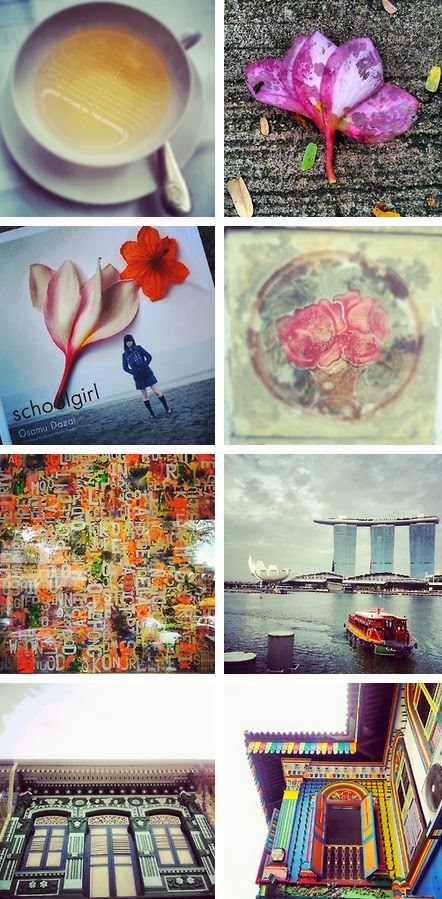
A large part of my time has been spent in India and Singapore.  More on that later.  Above a small sample of my instagramming of  Singapore (click for a larger view) - the two most ubiquitous symbols of the city are the mobile phone and food after all:)

I just realised it's been ages since I was on blogger and I am fumbling with layouts and templates. Tumblr seems like a natural home these days though I haven't been able to get the time to do a concentrated amount of work on it.  It was lucky I had a backlog that could be readily queued allowing me to coast along a bit on the vintage Indian clothing posts. It remains my joy and I feel the odd bit of pride when a particularly nice compliment comes my way.  And anyone reading this blog who is an illustrator I am badly in need of a like minded collaborator!

Leaving Sydney

It's been more than 5 months since I left Sydney though I went back for a few weeks to wind up and clear out my flat.  The years since I came back from a brief stint in Brisbane and resumed my old life seem to have coalesced into one. In between there was an incapacitating illness, deaths in the family, a very blue year, travel back and forth.  The mid point of this marked a transition, a new phase in life where everything is quietly hopeful, quietly hopeless. Yet I could not say I was unhappy.  Rather if I felt afresh the shock of grief, I felt happiness. And too keenly at times.  At the point when I was ill and had days to myself and the year was blue, blue, blue I would often walk around slowly in the afternoon. The day as often in Sydney would be mildly sunny, small pink eucalypt flowers would litter the ground, my niece would come rushing to the door of her house if I was in the neighbourhood and dropped by and life would feel absolutely simple for a moment.  I never feel this way elsewhere.

When I was a child, my brother and I lingered at a house with a TV, a rarity those days.  A documentary on the Nullarbor plain was screening and something in it held us rapt. My aunt had moved early on to Australia, to us inured to American tales it felt suitably distant and different. My Brilliant Career spoke to me as a teen. Years later in my first serious relationship which happened to be long distance, my then boyfriend was briefly working in Perth. It was the only time I considered dropping everything to move.  In a way the country held a place in my imagination.  It lay in wait for me as I for it.  I am not Australian, rather there are parts to the country that suit me. And there is no other place outside of India that feels this way. For the moment it is goodbye and there has been much to feel happy about by way of family and being home. Which is the reason for moving. But for all its distance Sydney remains a second home and I think about my years there often.

14 May 2013

Things I Like


Right now I am reading The Maias. Its a door stopper of a book and I want to bunk a day's work and curl up and devour it all in one gulp. Sadly I snatch reading time here and there to take it in. Thus far it is a classy soap that loves exclamation marks but that is just the plot, there is so much going on and Eca de Q is having so much fun and at the same time it is a sprawling, leisurely commentary on 19th century Portugal and I am entirely captivated and can't wait to finish it and restart all over again. Also I think I really really need to visit Portugal because whatever little I have seen and read (Mysteries of Lisbon, you are perfect) has been so absorbing and interesting that you have to remind yourself that these people are writing about themselves as the backwater of Europe.


I spend way too much time on tumblr, its like a rabbit hole you fall into and then you reappear and you want to write #IDK #holy fuck #excuse his beauty #obsessive replaying #cuz why not - because those are the tags you see along with other even more incoherent fangirling tags and then you realise that unlike most of tumblr which is VERY YOUNG you are on the wrong side of 40 and well perhaps a lyricist like Johnny Flynn doesn't quite deserve that and on that note here is his song, I am Light.  Only Nick Drake is rotated more often in Chez Anu. Pic Source here. And IDK is I don't know:)


And lastly, three cheers for Caravan which gets top marks not for being a great mag but for actually posting my favourite short story, Ras, in a new translation.  Even Indian cinema couldn't ruin it, not that it didn't try (to be fair it wasn't bad).


29 April 2013

Jane & Edward


In India, back in the day DD2 - bless them - would erratically screen UK TV programs and at the time they were the highlight of our TV viewing (yes cousins we have still not forgiven you for ruining the taping of a Jeeves and Wooster episode!).   Now that I have moved away, with UK shows being terribly commonplace here they no longer hold the same appeal. As an e.g. if Hugh Laurie and Stephen Fry appeared together in an episode of QI I would forgo it for an hour of…anything really.  Then one might even watch The Far Pavilions on the basis that the “British do period drama so well” but of course like Downton Abbey (a show I haven't bothered with) it was just an overblown soap with pretty looking people in historical costumes.   Recent sporadic viewings of respectively the very hokey The Paradise which never felt like anything Zola wrote and the more ambitious Parade’s End which took itself far too seriously and was deadly dull decided me that my rule of strictly rationed British TV period fare was warranted.  And then I saw Jane Eyre 2006.

Bronte’s novel of course heads must read lists. Mr Rochester is apparently everyone’s idea of a romantic hero and every now and then a film/TV version comes out which is duly whetted and slobbered over by the fan girls and further distances male viewers (with exceptions).  So though I did read positive reviews of the 2006 version I stayed away, more so since I didn't like the 2011 version – I went with my cousin for a girls night out and half way through we began regretting the unfinished wine bottle that we couldn't smuggle into the theatre.  The only version I did like was Welles'  version but that was not due to the movie itself or the performances in themselves. Rather I am a sucker for beautiful speaking voices and Welles' is top-shelf.  And then when I did get around to seeing the 2006 version, I was more than pleasantly surprised.  The production has its faults – the two segments that bookend the novel and do not feature Mr Rochester - Jane’s childhood and her time with St John and his sisters is fairly weak.  But it makes up for that with its central story which is so very charged that you finally see why Jane Eyre is an enduring romance.  All of this has to do with the leads. For the purists they do not exactly resemble their novel counterparts, nevertheless they do create the passion and feeling at the heart of what is an uncommon romance.  Ms Wilson’s performance is effectively restrained and filmic but Mr Stephens performance has dual qualities - old fashioned theatricality mixed with the toned down approach of film.  Normally I prefer the latter but some parts call for an actor who can manipulate language and knows how to deliver dialogue (and I have to admit that I miss this in modern film, both in India and elsewhere few actors know how to clearly enunciate and speak their lines) and Mr Stephens is adept at this.  On the other hand the performance is not all thespy either i.e. the kind of "look I am acting and I have cut glass vowels" performance which undermines so much British period drama or even the Orson Welles version. The proposal scene in Jane Eyre lies at the heart of the novel for it is not a simple proposal but also hints at Mr Rochester’s past and what is to come.  It requires not just a mellifluous reading of the lines but the line reading also has to convey Mr Rochester’s inner conflict. In this version it is particularly well done by Mr Stephens.  Unusually for a novel perceived as a romance for ladies, it has a very complex male character at the centre (he is also umm rather verbose!) and Mr Stephens digs into the role with relish and delivers and more (Indian audiences may know the actor from Mangal Pandey-and the actor really should have played Flashman, Update - well he has read the part!).   

All in all I felt myself ready to watch a bit more British drama:) And for once the interviews on the DVD extras were thoughtful and interesting.

Bronte’s novel isn't popular with everyone.  There have been postcolonial interpretations – and I am surprised the French haven’t complained yet (there is a good degree of this kind of insularity and protestant christianity in Bronte's novels, they are very much of their time).  For the new feminists Mr Rochester is the worst kind of male ideal, a forerunner of the bad boy and just the kind of man any sensible woman should avoid.  Comparisons with Austen come up though Bronte wasn't a fan (and the funniest comparisons of Rochester and Darcy apparently have no comments).  All this of course misses the point because Austen and Bronte are very different writers loosely united by that hateful phrase of our time, chick-lit.  Jane Eyre remains on reading lists because it is a beautifully constructed, powerfully written novel. Second Jane Eyre is not just a romantic novel.  It is not solely about finding the right husband in a society where cads and bores abound a la Austen.  Rather it’s about passion and feeling,  injustice and goodness, hypocrisy and cruelty and about being female and in the world.  Bronte feels all this very keenly - in Jane Eyre and in much of her other work.  Unlike Austen, Bronte’s  novels are not exactly romantic templates and unlike Austen her men are flawed and real.  Jane and Rochester are singular people and their romance equally singular, despite the lists it is not an "archetype" romance like Pride and Prejudice.  And most important of all though Jane Eyre gets a “happy ending”, you can imagine her life without it too.  Unlike Austen's novels where marriage is the logical end point, Bronte’s girl is her own person – you feel that with or without Mr Rochester she would have made her way through life on her own terms.  

__*__

My favourite period drama pieces however still remain non-British and rather French.  I loved The Mysteries of Lisbon (and Time Regained), the former I could watch endlessly.  I loved Breillat’s An Old Mistress.  And Untold Scandal was probably the best version of Dangerous Liaisons.