19 December 2010

Old Times. New Times.

Work is very busy. Plus the little bit of time I have has been spent on late night hanging around news sites thanks to wikileaks ☺ But I don’t blog on work or politics so I will turn my thoughts briefly to music I recently blogged about. Partly because its been my background soundtrack for the past few weeks. Most of this has been a fair few rousing Decemberists songs. And can I say that if was 25 I might have entertained the thought of having a wee crush on its lead singer, Colin Meloy?!


Quite a few Decemberists songs are like old timey stuff made fresh. Like someone rummaged through old ballads, sea shanties, agricultural work songs and the like and made up whole new tales. Plus they love songs of doomed love. There is a degree of artifice and hyperliterateness about the lyrics of these songs for which I think the band has been criticised (as well as for its small degree of musical plundering) but I quite enjoy these new constructions from old materials. And Meloy's distinctive voice. Some of the songs are political but as always happens its when the personal seeps into a song that it becomes both simple and touching as in this song about the birth of his son.

Now in spite of the aforementioned potential crush, Meloy is no matinee idol. Johnny Flynn could be or well at the very least he needs to be put in a period film fast.


Flynn’s songs are also clearly influenced by British and American folk songs. His songs are also hyperliterate but unlike the Decemberists he is far more reflective and perhaps far more elegant in the construction of his verse. One of the reviews on the singer touched on his possibly being the best songwriter of his generation and this may well be true, I can't think of any other singer I have liked as much as Nick Drake. He is nowhere as well known as Mumford & Sons and Marling, perhaps his songs are not as accessible. Also they seem to be primarily poetry. And there do seem to be a few of his poems around, like this one

And keeping with the old timey theme, I have also been reading tweets of old sporadically and amusing myself. "Several at this place are becoming attached to the outside world by having telephones put in their houses" - indeed!

And last, it’s been ages since I bothered with the foreign Oscar winners. Too many seem intended for a bourgeois audience who can congratulate themselves on their good taste. I had Babette’s Feast somewhere in my chest of DVDs (!!) but dug it out just this Friday. Based on an Isak Dinensen story, it turned out to be both old timey and unexpectedly good. Maybe the slowness, the philosophical nature of the film was a welcome respite after a long week.

13 December 2010

In a Forest

In the woods we return to reason and faith - R.W. Emerson

Several years ago in the midst of a fractious, deeply unhappy love affair I took a trip to Saputara. It was ostensibly an effort to recapture some of the initial spark of the affair though truth be told it was clear it was not going to happen. Still, P and I packed for the week and my trusted Maruti 800 was put into service with the two of us alternating the driving.

Driving clears one’s head. So does any movement, we think often of getting into a bus to no particular destination.   Already leaving Mumbai, the air felt a bit clearer in more ways than one.  We stopped for fresh fish and sweet tea at a shack by a lake.  Then on to Nasik where P had worked for awhile in a factory. We walked around a bit, the lanes were flanked by fields, the moon shone down.  We took a tour of the factory, oddly enough the cool gleam of the machines on a night shift was the beginning of some peace between us.

The Mumbai-Nasik road is a thoroughfare.  There are trucks, cars, small towns, people on the move, the flow of commerce.  Pulling away from Nasik things change.  The roads are not as busy, the countryside full of vineyards.  The rainy season had just ended leaving everything verdant.  One could sleep on an arm resting on the window, feel the sun on one’s face.  We expected  Saputara to be some distance after we passed Gujarat but suddenly it was upon us.  A hill station of sorts, this was the off season and the hotels lay empty.  Most were ordinary and built for a predominantly Gujarati  clientele, the staff a motley lot who had hotel degrees from small towns.  We initially checked into one of these till P, ever intrepid, found a picturesque State tourist cottage on a cliff.  On this we agreed,  its rusticity, its lack of conveniences. 

Time passed slowly, amicably.  The usual help ferried up the toast-tea-oily omelet breakfasts of government circuit houses. We walked around the quiet town, ate at the few hotels.  One night we heard singing from a village down below the cliff side.  Ahead of Saputara stretched the Dangs, the songs were tribal.   The next day we took the car into the forests.  Forests in a manner of speaking, for there was a road, small vehicles, tiny hamlets.  Still, the roads passed trees filled with sunlight, rivers in which women and children swam, all around a different world to the one we had left.  We drove up to Ahwa, which for a district headquarters was fairly pitiful,  largely because the Dangs was tribal, neglected, poor.   At the midday hour when we arrived, the streets were full of children in uniforms.  The politics of the Dangs was evident in Ahwa, not long back the district had been embroiled in clashes.  It wasn’t just the clashes.  We had stopped by a river only to step on broken beer bottles.  And not far from where we stopped, a few men, possibly small time businessmen from elsewhere, had set up an alcohol party.  Their spot commanded a view of the river, no doubt to better spot the near naked tribal women who swam there.  In the town, we went to see an Ayurvedic centre where medicines were being packed.  The man in charge had come from up north; he took it upon himself to explain the “loose morals” of the locals.  It appeared alcohol flowed freely, women frequently left their partners.  To us he had every appearance of having a mistress of his own.

So we wandered, mellowed and more friendly than we had been in the past months. At a botanical garden with neat hand painted signs identifying species, the trees loomed over us.  A sign informed us of a village with an inhabitant who had been to the Festival of India, we went in and bought a few pieces made of the local bamboo.  The man patiently fixed the horns of the deer while we sat and watched.  The deer seemed alive, their grace somehow captured in that piece of wood. The village was neat, small houses, small lots with greens.  Then the drive back in darkness, the faint snatches of song from the valley.  Then the hilltop cottage, alone and mysterious in the night light. 

Some days later we drove back.  Driving to the Dangs, we had imperceptibly slipped into a different way of life.  Returning felt different. By the time we hit Mumbai and stopped at a local cafĂ© to eat, the shock of immersion in what was our life was disorienting.  I went home to meet my uncle who had taken ill, P flew back to tackle his own demons.  By the end of the year, my life felt unravelled and it would take more than a few months and a move to another continent to put it all back together again. It was not a happy time, it was not a time of reason or calm, it was not an admirable time.

For a long time I used to think of the Dangs. Not as a brief romantic interlude though it was that.  I am drawn to forests and hills, to mists and cold, to houses on cliffs.  To deer, to the whirling of birds in skies.  The closed nature of hill people, the grubby faces of their children.  To rivers, to women who freely revel in its waters.  I used to close my eyes and think for the longest time of how little all this was present in my life.

5 December 2010

Making Things

There was rain predicted for the weekend but it turned out to be sunny, if a little cool.

My craft skills are amateurish but I like making something or the other, I suppose it is relaxing in the way some people may find cooking or playing a game to be a restful hobby.  My earliest memory of making something was my mother, brother and me making cards for his birthday party when he was 6 or 7. My mother had found an old book with sweet animal illustrations which we used to make the invitation cards.  I still make my own cards.

Most things I make happen serendipitously.  I find things when walking or something may catch my attention in the shops and I pile them up in boxes and then just put them together when I am making something.  The pieces above were found over several years in different places, the felt background was a little dyeing experiment.  I am undecided on whether to leave it as cards or to frame them.

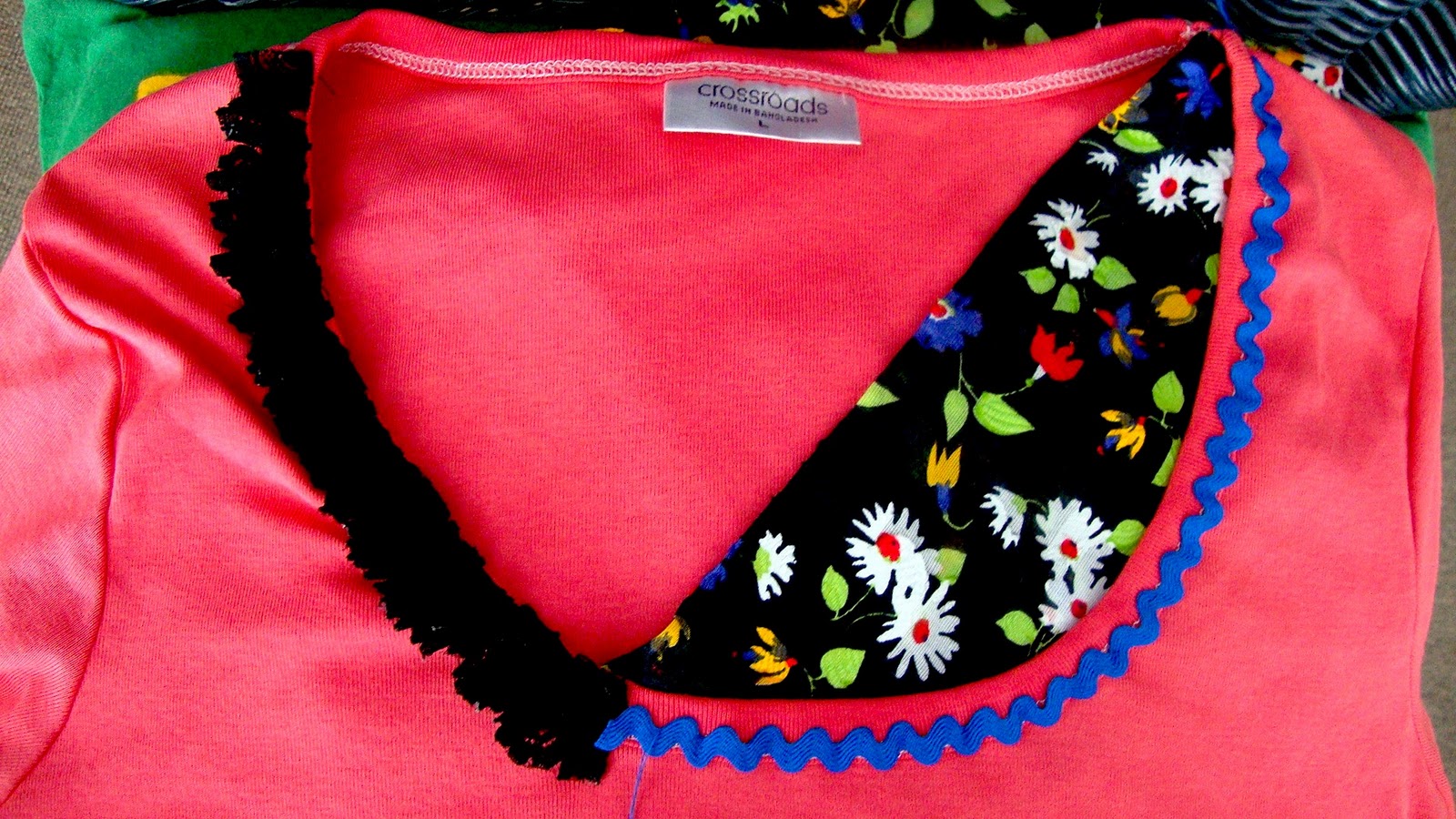
Left over fabric scraps are part of the beginnings of the tee shirt above that I started this weekend - I don't know yet how it will go though I might be painting a bit on the hem when I have the time.  The jewellery purse below it is complete, its a shoulder pad from an 80s dress. I have been putting these to many uses and I fear I may soon be buying dresses for the pads.  The brass bit was a lost earring I found on the street. I quite like how it all came speedily together. 


I pretty much use the same approach with the house.  My brother and I have never really planned the look of any place we have lived in, we rely on an inner aesthetic coherence when we acquire (or retain) things piece meal.  Neither does it follow any particular order, I like propping up paintings on the floor.  By and large most places we have lived in have had an organic and folksy element with a definite pop of colour.  I like to bring the outdoors in a little bit and that frond must be the largest thing I ever carried in.

28 November 2010

Train Commute Reading

The slow slow nature of reading on a train commute meant I have taken awhile to finish two books.

Daniyal Mueenuddin’s In Other Rooms, Other Wonders is an accomplished book but so quiet in its tone that one hesitates to leap forth as it were and announce to the world at large, “you must read this book!” Even though it is entirely deserving of such an emotion.  The short stories, largely set in rural Pakistan and in the drawing rooms of the country’s rich, are beautifully written but underneath the cool and precise prose runs an acute understanding of the life of the characters that populate the book.   Rather loosely structured around a zamindar sort called K.K. Harouni, the book is - rather surprisingly for our age - anchored in a feudal way of life where the master’s immense wealth and power flows from land. The preface to the book is a Punjabi saying, “Three things for which we kill - land, women and gold” which pretty much sets the tone. This wealth and land supports a whole ecosystem of employees and hanger-ons, some merely trying to survive, others lording it over their own minor domains and feathering their nests and in one of the stories, nurturing political ambitions.  Remarkably the book doesn’t take any sides, though the stories make it clear that everyone in one way or the other pays a price.  To my mind the fact that it not a polemic but a study of the mores and morals of a society is one of the strengths of the book. It isn’t that the stories are without compassion; in fact the even narrative only renders poignant the fate of some of the characters. The story “Saleema”, for e.g., ends with one of those lines that suddenly catch at one’s heart when it refers to a child who begs in the streets, one of the “sparrows of Lahore”. “A Spoiled Man” is similarly affecting.  A few of the stories, like “Our Lady of Paris” and "Lily” are wholly urban in tone and slightly reminiscent of Jhumpa Lahiri’s stories.  I particularly liked Lily, where a society girl marries a farmer but is unable to leave behind her old life. The odd one out in these stories is “About a Burning Girl”, where a judge has to settle a case involving his bearer and the lighthearted first person narrative on how everyone is complicit in “fixing” a case only underlines the horrific nature of the crime (the stove accident so common in the subcontinent).  Many of the stories are set in the Punjab and I hadn’t thought much of the natural beauties of Pakistan but here they are in this book, particularly in Lily where the title character and her paramour venture out into a countryside marked by hills and the river Indus.  It’s perhaps descriptions of lives like this as well as the structure of the stories that results in Chekhovian comparisons in the book blurb.  The comparison is not unjustified.

The title appears to reference Fitzgerald, yet “All the Sad Young Literary Men” is an unpromising title for a book that has its charms.  This book on umm- melancholic literary sorts-follows the ambitions of three literary Americans with pronounced reference to both Jewishness (and hence Israel) as well as Russia.  Their experiences are necessarily shallow, perhaps even intentionally shallow.  There are lots of references to historical events in the context of personal events.  In spite of a knowingness to this, it can at times be irritating if an author is setting out the differences between Mensheviks and Bolsheviks and relating it to girl trouble on an American campus.  You don’t mind the history but wish it had been more personal e.g. about the non-English speaking immigrant parents of one of the characters who seem to demand a novel of their own. In the end it seemed a bit like a Godard film. It has moments of sly wit, it is acutely political but ultimately it is a tale of young men and their girls served up with a small dose of misogyny.

25 November 2010

Summertime


Its early summer here; the days are warm, the skies are blue and the evenings cool. I set out to photograph the blue jacarandas before their brief glory disappeared but ended up taking lots of photographs given that the gardens up and down the streets are all in bloom. Pictures here.

And here below is Sam Cooke's version of a famous song, Summertime


And just for added measure here is the great Paul Robeson's old timey version.

22 November 2010

Akhmatova in Translation

Reading things in translation, one is never sure if the meaning is lost. Take Anna Akhmatova's poem, The Last Toast, of which numerous versions exist on the Net.

I drink to home, that is lost,
To evil life of mine,
To loneness in which we’re both,
And to your future, fine, --

To lips by which I was betrayed,
To eyes that deathly cold,
To that the world is bad and that
We were not saved by God.

Another translation:

I drink to the wreck of our life together,
And the pain of living alone.
I drink to the loneliness we share--
My dear, I drink to you.

I drink to the trick of a mouth that betrayed me,
To the eyes and the look that lied.
I drink to the terrible world we inhabit
And to God, who never replied.

The second one is far more elegant and understandable (in translation i.e.) but the first may well be a literal translation. And in some lines, the intent appears to be different.

Still, whichever way it is translated, there is an immediacy and beauty to Akhamtova's poems. And she was clearly a woman who knew how to convey much by being both elliptical and economical with words.

16 November 2010

Three From India

It isn’t until I came to Sydney that I started watching movies on a regular basis. The foreign films on SBS were a catalyst – as were super cheap DVDs from a brother based in SE Asia :-)

In spite of the movie watching I still feel a bit bemused by visual media, well at least the entertainment part of it.  There’s something a little strange about an entire industry composed of people play acting so we can be as the saying goes, amused to death.   Theatre aka playacting has been around forever, nevertheless it feels different.  For one it is a labour intensive enterprise which limits the endless reruns of television or movie halls.  And at least some parts of it are part of a continuing tradition of storytelling, like an annual Ram Leela.  So watching grown up people act out endless made up tales can sometimes feel like a waste of time.

Of course in the world at large the appetite for manufactured tales only seems to be increasing.  And perhaps nowhere more so than in India which must surely lead the world in terms of sheer output, both on the big screen and by way of television. A pity then that in this vast outpouring, there is hardly anything of merit. One may extol Bollywood’s campiness and joy and there are blogs devoted to it as an art form but to me it often seems like the ice golas of my childhood, highly coloured and sweetened on the outside but tasteless once past the surface. And while Indian arthouse films have conventionally existed in the slipstream of popular cinema and are a welcome corrective to the general dross, many simply aren’t as good as films made elsewhere. Of the movies I picked up while in India this is true of two movies that I saw recently, Ishqiya and Love, Sex aur Dhoka.  On their own they are a change from the bewildering mess of most Indian movies (here I include lauded movies like 3 Idiots, which did its best to live up to the latter part of its title) but they still fall way short of the movies that normally find themselves awarded on the festival circuit.

Ishqiya is part of a genre that can best be termed the bawdy UP sex caper though to be honest the only similar movie I have seen is Omkara which is hardly a caper.  Still one knows the type, an ostensibly rustic film set in Northern badlands featuring bad ass men, lusty wenches and accents broad enough to convince urban filmgoers that the whole enterprise is entirely authentic. Ishqiya is no different though I can’t seem to recollect the mandatory item number with the usual mirchi laundiya descriptors.   Though Ms. Balan’s character is of that type even in respectable widowhood.  Add to this two small time crooks on the run and you have the classic caper. Then add to the mix a comic villain, a smart ass kid with the best dialogues, a few songs and it all jogs along nicely enough till it falls apart quite spectacularly half way through and limps its way to a supposedly clever ending.  Any resemblance to the real UP is purely coincidental.  It could have been better to be truly enjoyable, as it is I think one is supposed to feel grateful that it exists at all. 

Khosla ka Ghosla was a nice enough addition to the kind of cinema Indian filmmakers do best, i.e. the joys and travails of the middle class. I can’t quite trace its origins but the genre certainly peaked with the charming and inoffensive movies of the Chatterjee-Mukherjee brigade in the 70s and even some Ray-Sen movies in many ways belong to this genre.  Few movies effectively capture Delhi, all of Dibakar Banerjee’s do, though this Delhi is a far cry from the Delhi of Chashme Buddoor.  Similarly Oye Lucky! Lucky Oye! was also very effective in immersing the viewer in the Delhi of the lower middle classes but somehow its faintly surreal tone was lost on me.  And the Paresh Rawal bit weakened the film.  LSD seems a companion piece on the nature of modern India but it too fell short in far too many ways.  It does have an affecting middle section (maybe its the actors who made this section) but on the whole it never rose beyond the ordinary.  It is not your average Bollywood flick for sure but surely by now this is a filmmaker who should be measured against his international contemporaries. And if one does so, the movie falls short. The different modes of filming for the three sections (briefly, the honour killing, the sex tape and the sting operation), the general observations on a voyeuristic society where everything is filmed, and the stories themselves never really transcend the obvious and you have the feeling you have seen it all before.  In short, the richly bizarre, cruel, delicate, subversive and contradictory realities of India far outstrip any attempt at fictionalisation and the movie itself fails to see beneath this surface.

The third movie I saw Wake up Sid doesn’t seem to fall into the conventional Bollywood/Arthouse divide. Rather it is an indie film on the lives of self-absorbed twenty somethings that owes much to its American progenitors. But because it doesn’t want to be anything else than a slight, coming of age roman Ă  clef, it has its charms.  It is undemanding and sweetly performed, though Ranbir Kapoor at times reminded me of a line from a Keith Gessen novel where Gessen tartly observes that people’s expressions were now down to the few arch mannerisms of television shows. Surprisingly, in spite of the slightness it had a genuinely affecting ending, helped along by this song.

This song works but on the whole can Indian cinema leave song interludes behind?!

And now to non-amuse myself for awhile.

12 November 2010

Things I Made

Doilies. Tea. Beads. Sequins. Buttons. Fabric scraps. Needle&Thread.

I took put of my boxes of embellishments last month and decided to work on some plain tops I had as gifts for people I know. All are variations on the same theme.

1. I can't crochet so those pieces were bought.  The T and the crochet pieces were overdyed and the rest was just a matter of putting the crochet pieces, sequins and beads together.


2. Much the same for the piece below.  The T and the crochet pieces are however tea dyed, the dye held up quite well.


3. For the linen piece below the pieces were slightly varied. I pieced together the small and larger crochet pieces along with black beads for the brooch like embellishment. The shoulder embellishment is brass beads, the centre floral motif  is from vintage cloth. Both have bee beads, my current love.


I particularly like the little pocket (below) which is part of a piece I found in a flea market, I like the Australiana of the eucalyptus embroidery. And the single hummingbird - so hard to get these beads.

4. And the last picture has the vestiges of 80s vintage frocks. Along with twigs, the shoulder pads from these frocks make for rough and ready blooms :-)


9 November 2010

Charles & Rebecca (may) hold hands

Slow Club's wistful ode to the possibilities of an almost coupling up at different stages of life.

6 November 2010

One Day

Extract from Tagore:

Rainy Day, Frank Benson
"I remember that afternoon.  From time to time the rain would slacken, then a gust of wind would madden it again. 

It was dark inside the room, and I could not concentrate on work. I took my instrument in my hand and began a monsoon song in the mode of Malhar. 

She came out of the next room and came just up to the door. Then she went back. Once more she came and stood outside the door. After that she slowly came in and sat down. She had some sewing in her hand, with her head lowered  she kept working at it. Later she stopped sewing and sat looking at the blurred trees outside the window. 

The rain slowed, my song came to an end. She got up and went to braid her hair. 

Nothing but this. Just that one afternoon twined with rain and song and idling and darkness. 

Stories of kings and wars are scattered cheaply in history. But a tiny fragment of an afternoon story stays hidden in time's box like a rare jewel. Only two people know  of it."